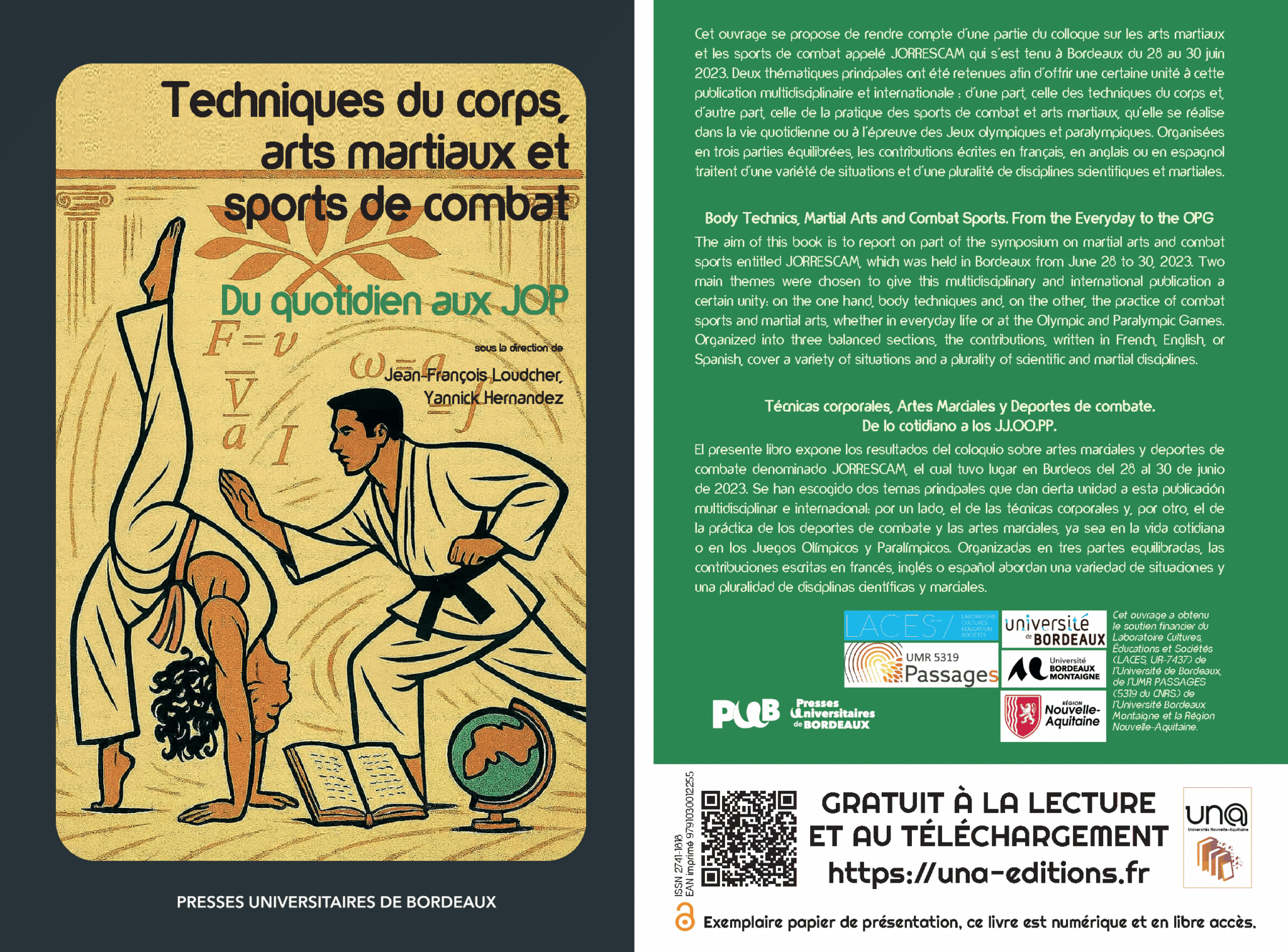

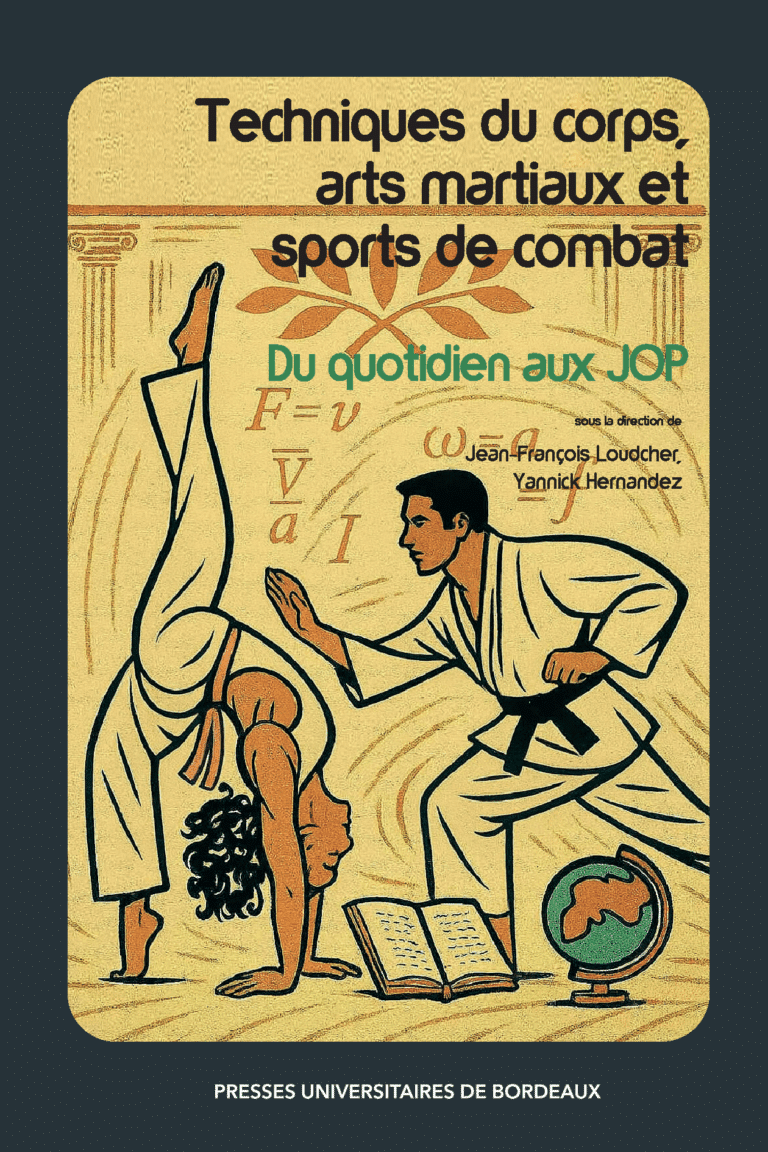

This book aims to report on the symposium on martial arts and combat sports called JORRESCAM1, which was held in Bordeaux from June 28 to 30, 2023, thanks to the support of the University of Bordeaux, Bordeaux Montaigne University, UFSTAPS, the Cultures, Education, and Society Laboratory (LACES) and the PASSAGES joint research unit (5319 of the CNRS) and the Nouvelle-Aquitaine Region. However, only a partial overview of these days can be given here. From the outset, they have been presented as a multi-party meeting where scientific and popular communications are combined with various workshops enriched by formal and informal discussions, all punctuated by convivial moments, and it is therefore impossible to transcribe them in their entirety. The aim is to bring together professionals and amateurs with those from the academic sphere in order to stimulate or strengthen collaboration between academics, practitioners, local authorities, and even the commercial and industrial sectors. Federations, clubs, and sometimes companies are traditionally invited to participate in these JORRESCAM events, as the academic world must also be attentive to requests and proposals that are often closer to the field. This symposium was therefore an opportunity to stimulate these exchanges by joining the now widespread French and European approach of “Science with and for Society” (SAPS). In the Bordeaux region, partnerships with the Dojo Béglais and SAM (Sport Athlétique Mérignacais) enabled participants to practice judo and savate respectively, but they also helped to organize meetings and debates, notably with the workshop offered by the former on the sporting, social, and territorial development of a combat sports club.
However, while this diversity is a valuable asset, it is difficult to bring all these stakeholders together, and the field of combat sports and martial arts2 reinforces this difficulty, as it already includes a wide range of stakeholders from the professional and amateur worlds, as well as those from the academic sphere, in order to stimulate or strengthen collaboration between academics, practitioners, local authorities, and even the commercial and industrial sectors. Although the editors of this publication were keen to maintain this focus, two main themes were nevertheless chosen in order to give the publication a certain unity: on the one hand, body techniques (BT) and, on the other hand, the practice of combat sports and martial arts, whether in daily life or at the Olympic and Paralympic Games (Body Technics, Martial Arts and Combat Sports, From everyday life to the Olympics and Paralympic Games; Técnicas Corporales, Artes Marciales Y Deportes de Combate: De lo cotidiano a los Juegos Olímpicos y Paralímpicos). This dual theme has made it possible to address both physical habits in elite sports and less intense physical practices, whether they are embodied in self-organized activities or in various social institutions through their practical, virtual, or media implementation. Of course, any thematic crossover was possible, giving rise to the second chapter of this book, which focuses on learning and teaching. The last section, meanwhile, little mention of the concept of BT due to the diversity of themes chosen for this Bordeaux conference.
Thus, many of the presentations often addressed more specialized topics. There are several reasons for this. The first is undoubtedly a relative distance, or even a feeling of incomprehension, on the part of the various sectors involved, particularly in terms of the ways in which each presents its arguments. This book therefore emphasized the need to clarify the use of arguments, working hypotheses, theories, methodologies, and personal experiences. But beyond that, it is an opportunity to recall that, while the academic world may undoubtedly prefer experiments defined according to traditional protocols, it must also be able to engage with and accept research results or projects derived from less conventional approaches, such as clinical, empirical, or even pragmatic approaches. Conversely, the professional world and the world of independent research must also be able to adhere to the rigor of an academic approach, at least in terms of written output.
A second reason undoubtedly lies in the significant development of this sector in recent years, both in terms of research and innovation. While historically the field of sports science in France (STAPS), which has been multidisciplinary since its inception, has been the main focus of these conferences, research has become so specialized that work now comes from a variety of scientific fields. This trend, which had already been observed previously, is confirmed in the work produced in Bordeaux. Biological and biomechanical sciences, as well as social sciences and humanities, have developed so profoundly that knowledge has reached such a level that it is sometimes difficult to advance this scientific diversity in tandem with the versatility of knowledge useful to civil society, and vice versa. Undoubtedly, this fragmentation of scientific fields enriches the approaches that open up multiple collaborations, but it must be noted that, apart from a few studies in the social sciences and humanities, often conducted through an epistemological lens, building bridges between these sectors remains a delicate task.
Aware of these difficulties, the editors of this publication chose the theme of BT in order to promote this transdisciplinary ambition, or at least to highlight it at the beginning of these proceedings, even though some publications make little or no reference to this concept. Thus, the field of combat sports and martial arts has this in common among the different disciplines that comprise it: very often, these BTs are based on fairly similar characteristics that allow for comparative analysis despite sometimes somewhat different purposes (production of forms such as katas and competition, for example). Whether in the field of health, leisure, or social inclusion, BTs are often determined by specific task goals (striking with particular parts of the body, knocking down, immobilizing, strangling, etc.) defined by rules specific to each activity. From a biomechanical, physiological, or even societal point of view, how does a tsuki differ from a straight punch in boxing, and why3?
The fifteen texts published in this book under the auspices of Presses Universitaires de Bordeaux (PUB) and on the UN@ platform meet a dual challenge. On the one hand, they appear in the language chosen by their authors, as the challenge of a trilingual conference was met throughout the presentations and round tables, thus responding to the diversity of participants from twelve different countries. On the other hand, in keeping with the tradition of JORRESCAM, the publications respect the diversity of themes and approaches. From biomechanics to history, epistemology, and pedagogy, purely academic works sit alongside more innovative texts in their approach, without ever compromising the rigor of the demonstrations, the richness of the ideas, or the ingenuity of the experimentation. This is guaranteed by double-blind peer review by independent experts. Coordinated by the two editors, the book is intended to be an introduction to diverse scientific cultures, which can nevertheless be understood thanks to the summaries in three languages.
Finally, the theme of BT offers a certain consistency of analysis, whether in daily sports, high-level sports, or the Olympic Games. And even if some texts may present a discrepancy, particularly in the last section, the ability to measure it restores a logical discourse in the field of combat sports and martial arts. Thus, the book focuses on the concept of BT also allows for comparative analyses outside this strict scope, as it goes beyond the overly technical or biomechanical aspect to which it is too often reduced4.
These texts are divided into three sections of roughly equal length; the first concerns BT, while the second deals more with learning and teaching, as well as innovation. The last section addresses the theme of daily practice and the Olympic and Paralympic Games.
The concept of BT is the key concept in the first part of this book. However, although it has been widely popularized since Marcel Mauss (1936), it is often used differently in the field of sports science5. The concept is indeed quite vague and sometimes gives rise to different interpretations depending on the scientific fields that adopt it. It was therefore necessary to clarify its contours, not only to validate the argument, but also to be able to offer possibilities for comparative studies. On this respect, Jean-François Loudcher’s text on offensive BT in boxing, based on a dual historical and epistemological approach (science and knowledge), provides some clarification. The author summarizes his previous work while proposing to go beyond it by clearly articulating the purely gestural aspect and the transmission aspect, which makes it possible to differentiate these BTs in terms of degree and nature. The work also highlights the very broad historical context in which they are formed. Indeed, it has been shown how body techniques are associated with “cultures”6 or civilizations, which must therefore be taken into account in order to understand their evolutionary potential. Thus, although karate originated in the Okinawa Islands, Western influences, particularly French ones, have been significant in the cultural transfer of knowledge in the expression of its modern form7. In this case, this approach requires not only “knowledge” of these “body techniques”, but also of the historical context in which they take on “meaning” in terms of their intended purposes, i.e., the social representations at work in a perspective of societal transformation. Matthias Röhrig Asunçao is very much in line with this kind of research with his study on the ginga of capoeira. The author clearly shows how this movement of guard, waiting, and/or preparation changes configuration according to the masters of this Brazilian art and, above all, according to the history that certain current schools interpret or reinterpret differently. Capoeira is also the subject of study by Alexandre Reubrecht who, in his approach of the grupos of Île de France, highlights the richness of the BTs used and, above all, the different meanings they take on for each of the representatives. Patrice Régnier and Oliver Bernard chose to compare the techniques of horse riders and karate practitioners over a long period of time. Admittedly, this is a risky exercise, but the use of Norbert Elias’ theory as a kind of tertium comparationis allows them to highlight their differences and similarities, all in the language of Shakespeare. Finally, it should be noted that Cédric Terret’s text on “modeling and characterizing standing judo technique by combining biomechanical and empirical approaches” has a multidisciplinary ambition. Indeed, this dual scientific and educational achievement is based on “a proposal based on state-of-the-art analysis”, i.e., epistemological work in the field of knowledge in this discipline.
In the second section of the book, more localized studies enable us to make the connection between practice, often determined by the use of BT, and its transmission. In this regard, the question of technology in the field of martial arts and combat sports is unavoidable. Instruments such as swords, canes, nunchaku, saï, bokken (wooden swords), sticks, and tonfa are regularly used by practitioners. In addition, all the equipment used to protect combatants, from gloves with varying degrees of padding to helmets, chest protectors, and other protective gear, as well as rings and tatami mats, is often linked to innovations in practice that also influence BT well beyond competitive sports, as Georges Vigarello has shown8. It is therefore understandable that these studies go far beyond the scope of combat sports and martial arts to include activities in the field of self-defense (Krav Maga, jiu-jitsu, etc.), or even warlike (military) or heritage-related (reenactment of medieval combat practices) activities. During these days in Bordeaux, Dov Ganchrow presented us with a very unusual piece of work. He developed a punching bag equipped with a computer vision system that uses movement to produce creative effects. It is important, of course, that this proposal be based on more rigorous scientific research, not only to fulfil its purpose, but also to improve learning. Isn’t this installation also an invitation to explore one’s body and bodily integrity in a different way? It is clear that opportunities could be envisaged with companies wishing to enter this market. In any case, information gathering and decision-making, as well as visual, cognitive and sensory feedback, are absolutely fundamental to these approaches, which can also be used for learning purposes. Generally grouped under the term ‘metrics’, there is no high-level competitive activity that does not incorporate sensors connected to cameras, accelerometers or force platforms. The work of Agnès Roby-Brami, Océane Dubois and Emmanuel Guigon on ‘controlling a Taichi sword’ thus makes it possible to investigate ‘defensive or offensive intentions’ using a high-performance protocol in order to achieve their ‘kinematic translation’. A whole range of cutting-edge technology, often initially reserved for elite athletes, has been developed and is becoming increasingly accessible to ordinary practitioners keen to invest themselves body and soul. In any case, body techniques are at the heart of these developments. What’s more, they are essential benchmarks of the skill required and acquired by the practitioner. Not only do they reflect their level, but they also make it possible to analyse their degree of integration developed through physical ‘routines’, particularly with regard to the physical condition required. Thus, when studied in the context of a more or less prolonged confrontation, technique tends to deteriorate9 and affect performance10. The combination of these technologies therefore makes it possible to link thousands of pieces of data in real time in order to determine the factors involved in technical performance, including physical condition, but also learning and teaching. It is, of course, possible to reflect on performance improvement using less instrumented protocols. Éric Margnes and Benoît Catala have developed an approach that focuses on “facing problems in Thai boxing”, particularly by examining “intervention strategies and [the] trainees’ perspective” based on pre- and post-learning situation tests. The authors conclude that problem situations involving high-level boxers are more effective in terms of learning because of the processes involved in the strategic approach. While BTs depend on more global situations, the boxer’s experience is at the center of the learning process.
While remaining in the realm of experience and learning, David S. Contreras Islas’ contribution stands out for its approach, which is in line with the tradition of phenomenological educational sciences in the German-speaking world. Written in Spanish, this chapter takes as its starting point a classic moment in a capoeira training session with a specific group in Mexico City. The “repetitive practice of capoeira movements” is approached as a “formative experience” (bildende Erfahrung) of “re-practice” (Umüben), a perspective that the author considers interesting in terms of enriching approaches to the practice of martial arts as a cultural process.
In the context of university teaching, Ai-Cheng Ho proposes an experience of practicing Taijiquan aimed at improving actors’ stage performance through their “Shēntǐ Gǎn 身體.” Based on situations where “body awareness” is central, pre-test and post-test evaluation situations are set up with several groups. The author concludes that this Chinese martial art practice is beneficial through the use and work on several technical forms.
Finally, the last part of the book, which deals with the experience of combat sports and martial arts, ranging from daily practice to Olympic competition, was chosen for contextual reasons due to the approach of the 2024 Olympic Games in Paris. Indeed, many researchers are involved in this topic, whether through historical, political11, organizational, or even training and educational work12. But it is personal experience that is the common thread running through this reflection. How has martial arts practice influenced individuals in their daily lives to the point where, for some, it has become a matter of life and death and, for others, an elitist or even Olympic pursuit?
Renaud Bouchet’s text on the “para-sculptural practice” of the artist Arman shows how martial arts (judo, karate, etc.) influenced not only his creative work but also his daily life and his extraordinary destiny, to the point where he sometimes expressed his art in the image of “Une Colère comme une projection de judo” (Anger like a judo throw).
The main objective of the European project developed by Raúl Camacho Pérez and Fernando Diéguez Rodríguez-Montero was to encourage older people to take up an Olympic sport such as judo in order to improve their daily well-being. This Spanish experiment is analyzed here through several contributions. Unlike France, where Taïso13 is promoted as “the ideal sport for seniors” and veteran judo competitions are becoming increasingly popular worldwide, this European project is experimenting with judo interventions adapted to seniors practised this discipline before. The aim is to achieve health, socialisation and quality of life benefits based on the educational principles of judo (e.g. fall control, movement, posture). Like the European project, the book in question brings together, as mentioned above, researchers, academics and professionals – in this case, internationally recognised judo masters – who contribute their expertise and fuel our thinking on martial arts and combat sports in everyday life.
The chapter by Recaredo Agulló Albuixech, Víctor Agulló Calatayud, Dayana Arteta Molina, and Helena Paricio de Castro reconstructs ‘the personal and sporting journey of José Martínez “El Tigre d’Alfara”’, European boxing champion. An exiled Republican during the Spanish Civil War, the authors demonstrate his importance from a sporting perspective and the consequences of his Republican commitment during the Franco era. They lament the invisibility of this figure in the sporting and cultural heritage of the Valencian Country, proposing to ‘promote and disseminate his legacy’. In this book, he links combat sports to politics.
Olympic wrestling and boxing in particular have been the subject of repeated scandals which, unfolding on an international political stage that is sometimes sensitive, may call into question their existence within the IOC, even though they have historically been part of this movement. Understanding the background to these negotiations provides greater insight into the issues at stake. The article by María Perrino Peña and Abel Figueiredo invites us to reflect on mixed martial arts and the paths to Olympic glory (‘Las MMA y su “camino hacia el Olimpo”’). But it is also Julie Pincot’s reflection on ‘The integration of kung fu wushu into the Olympic Games’ which, ‘seen from France’, takes on another dimension when ‘the modernisation of practices and the sportification of martial arts [are] at the heart of conflicts of representation and appropriation’. This perspective is particularly relevant when viewed in parallel with the development of a specific French sports policy: its governance, which has been the subject of much debate for years and was a central theme in the establishment of the National Sports Agency (ANS) between 2016 and 2019, has added an additional layer of complexity to the organisation of Chinese martial arts.
Finally, following in the footsteps of the JORRESCAM conferences of the last century, these days in Bordeaux were rich and intense in every respect. They received support from the Faculty of Physical Activity and Sport Sciences (INEF) at the Polytechnic University of Madrid, the Laboratory for Material-System Integration (IMS – UMR 5218), the UNESCO ISNoV Chair (Non-Violent Social Intervention), the Maison des Sciences de l’Homme de Bordeaux (MSHBx), the French Boxing Federation and the French Savate Boxing Federation and Associated Disciplines. Although this book provides only a brief overview, it nevertheless ensures the continuity of long-term study in the field of combat sports and martial arts, making this conference one of the oldest in the world in terms of its frequency and the resulting publications.
Notes
- The symposium known as JORRESCAM (JOurnées de Recherches et Réflexions sur les Sports de Combat et les Arts Martiaux, or Days of Research and Reflection on Combat Sports and Martial Arts) has been held fairly regularly every year, then every two years, since 1991, when it was launched and promoted by ARRESCAM (Association de Recherche et de Réflexion sur les Sports de Combats et les Arts Martiaux, or Association for Research and Reflection on Combat Sports and Martial Arts) and its president Jacques Crémieux. The proceedings of these conferences take various forms (CD-ROMs, books, etc.), reflecting the organizers’ desire to transcribe the debates while highlighting certain themes. These are not strictly speaking conference proceedings, as all the texts presented have been peer-reviewed using a double-blind process.
- Over the years, several writings have contributed to a more precise definition of what constitutes combat sports and martial arts. Cf. Loudcher Jean-François, “Arts de la guerre, arts martiaux et sports de combat ; une réflexion épistémologique et anthropologique”, in Loudcher Jean-François et Renaud Jean-Nicolas (dir.), Éducation, sports de combats et arts martiaux, Grenoble, PUG, 2011, 21-48.
- It should be noted that this type of comparative study was undertaken at the end of the 19th century by Georges Demeny, who analyzed, for example, the characteristics of a punch in English boxing and French boxing (savate). Together with Étienne-Jules Marey, they laid down the principles of biomechanical movement analysis that are widely used today, albeit with completely different technologies.
- Loudcher Jean-François, “Limites et perspectives de la notion de Technique du Corps de Marcel Mauss dans le domaine du sport”, STAPS, 91, 2011, 10-27.
- Ibid.
- Mauss Marcel, “Les techniques du corps”, Journal de Psychologie, 32, 3-4, 15 mars – 15 avril 1936. Communication présentée à la Société de Psychologie le 17 mai 1934.
- Notably through the three French military missions to Japan (1867-1887) and the influence of the Joinville Normal School of Gymnastics. Loudcher Jean-François and Faurillon Christian, “The influence of French gymnastics and military French boxing on the creation of modern karate (1867-1914)” https://mas.cardiffuniversitypress.org/articles/abstract/10.18573/mas.135/
- Vigarello Georges, Techniques d’hier… et d’aujourd’hui, Paris, R. Laffont, 1988.
- Terret Cédric, Analyse technologique des conduites motrices du judoka en contexte écologique au regard de niveaux d’expertise. Épistémologie de la mesure, objectivation par actimétrie et EMG, propositions d’intervention, PHD in sport sciences, Bordeaux University, 2021.
- Loudcher Jean-François developed a test in collaboration with Alain Groslambert and Frédéric Grappe in Besançon (LabCom) in 2001, called JEFFREDAL; it consisted of studying the deterioration of performance in an exercise similar to the task to be performed (5 rounds of 2 minutes). This test was part of a fighter’s physical and technical preparation for the world savate/French boxing championships. It was accompanied by a questionnaire based on the Borg scale, which the boxer completed between each round.
- Loudcher Jean-François, Hernandez Yannick, Alves Carlos, « Introduction : une approche interdisciplinaire à l’héritage sportif », Jurisport, 206, 2020, p. 17-18. Loudcher Jean-François, Suchet André, Soulier Pauline, Héritage sportif et dynamiques patrimoniales, PULM, 2002.
- Monnin Éric, Loudcher Jean-François, Férréol Gilles, Éducation et olympisme en Europe, Besançon, Presses Universitaires de l’UTBM, 2012.
- Fédération Française de Judo et DA : https://www.ffjudo.com/le-taiso (accessed on 30 May 2025).