

En préparation
Cet ouvrage est actuellement en cours d’édition.
Il sera prochainement disponible en accès ouvert.
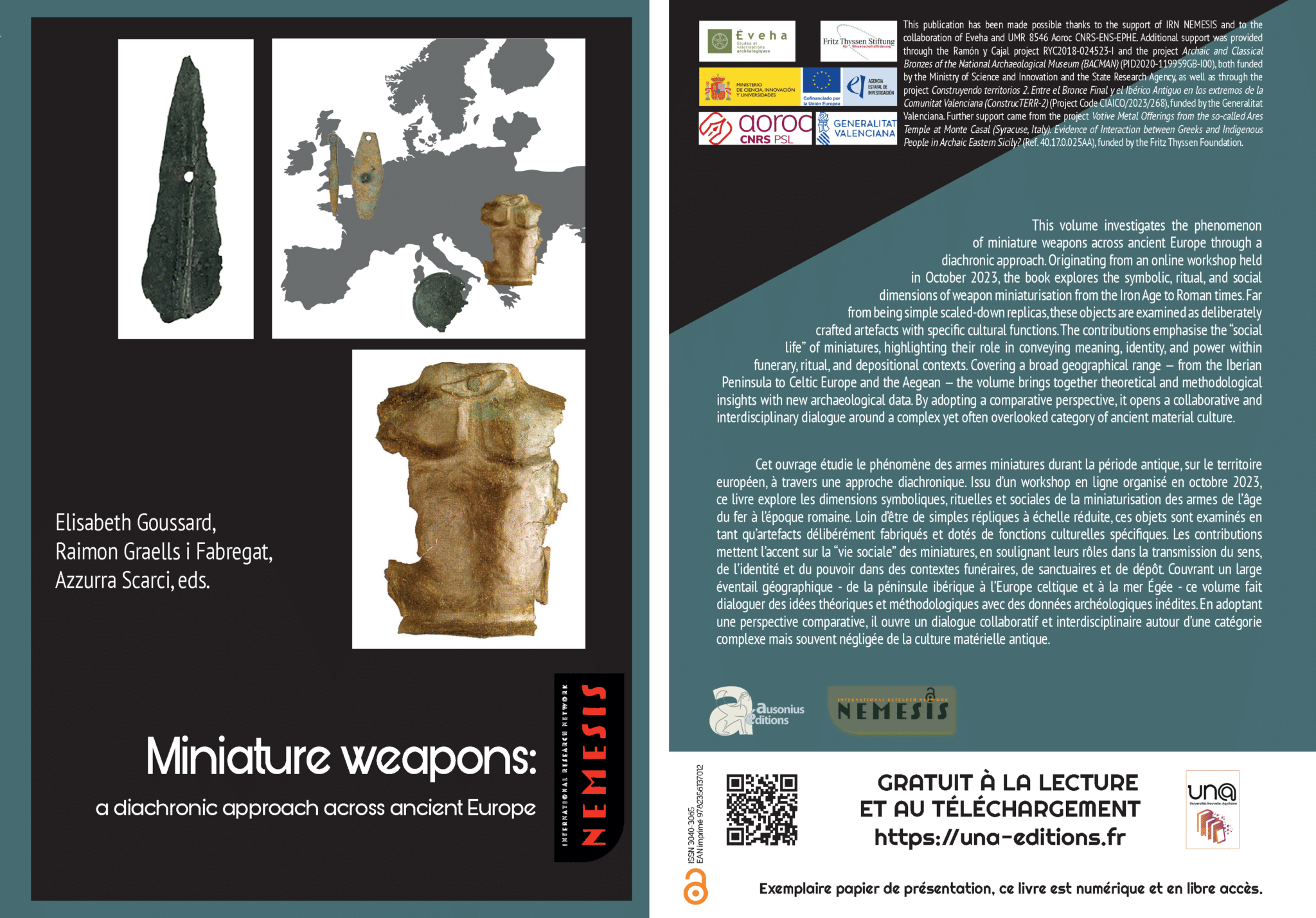
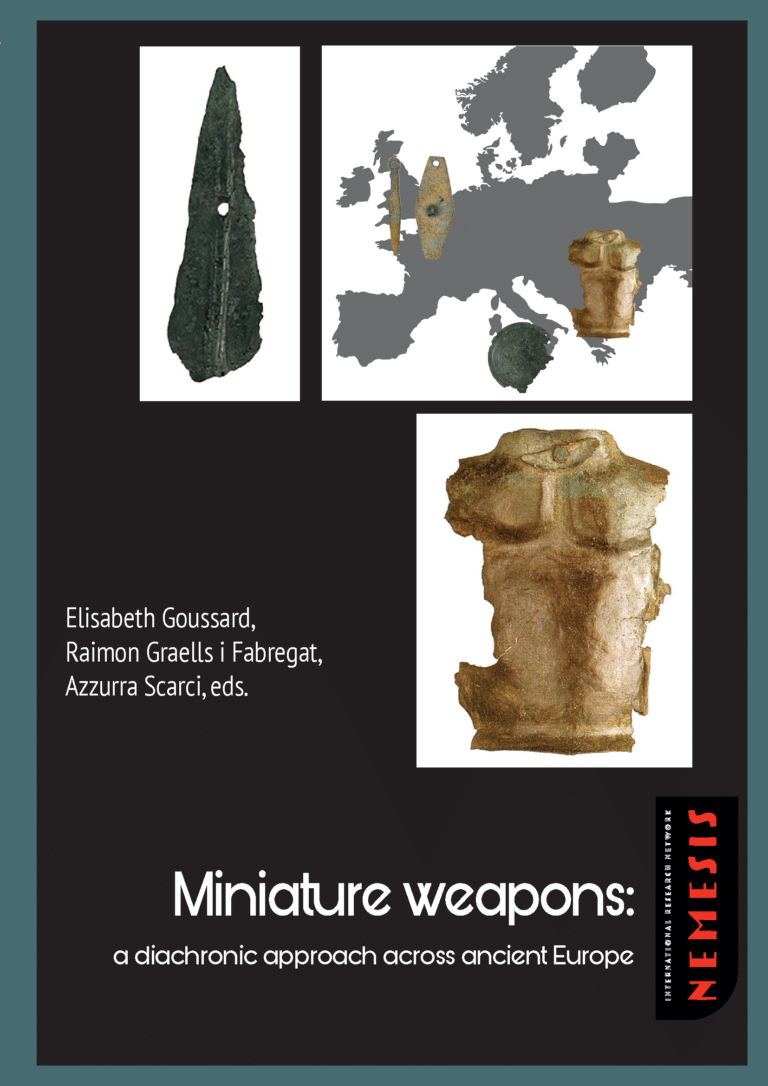
This volume investigates the phenomenon of miniature weapons across ancient Europe through a diachronic approach. Originating from an online workshop held in October 2023, the book explores the symbolic, ritual, and social dimensions of weapon miniaturisation from the Iron Age to Roman times. Far from being simple scaled-down replicas, these objects are examined as deliberately crafted artefacts with specific cultural functions. The contributions emphasise the “social life” of miniatures, highlighting their role in conveying meaning, identity, and power within funerary, ritual, and depositional contexts. Covering a broad geographical range — from the Iberian Peninsula to Celtic Europe and the Aegean — the volume brings together theoretical and methodological insights with new archaeological data. By adopting a comparative perspective, it opens a collaborative and interdisciplinary dialogue around a complex yet often overlooked category of ancient material culture.
Miniature; Miniaturisation; Weapons; Votive; Offerings; Offerings by destination/purpose; Offerings by transformation; Methodological reflections; Archaeology; Sanctuaries; Funeral context; Deposits; Europe; Greek world; Lucanian; Latin; Britain; Gaul; Sicily; Campania; Iberian world; Magna Graecia; Iron Age; Early Roman period; Archaic and Classical period; Hercules; Chariot; Pendant; Falcatas;
Cet ouvrage étudie le phénomène des armes miniatures durant la période antique, sur le territoire européen, à travers une approche diachronique. Issu d’un workshop en ligne organisé en octobre 2023, ce livre explore les dimensions symboliques, rituelles et sociales de la miniaturisation des armes de l’âge du fer à l’époque romaine. Loin d’être de simples répliques à échelle réduite, ces objets sont examinés en tant qu’artefacts délibérément fabriqués et dotés de fonctions culturelles spécifiques. Les contributions mettent l’accent sur la « vie sociale » des miniatures, en soulignant leurs rôles dans la transmission du sens, de l’identité et du pouvoir dans des contextes funéraires, de sanctuaires et de dépôt. Couvrant un large éventail géographique – de la péninsule ibérique à l’Europe celtique et à la mer Égée – ce volume fait dialoguer des idées théoriques et méthodologiques avec des données archéologiques inédites. En adoptant une perspective comparative, il ouvre un dialogue collaboratif et interdisciplinaire autour d’une catégorie complexe mais souvent négligée de la culture matérielle antique.
miniature; miniaturisation; armes; votif; offrandes; offrandes par destination; offrandes par transformation; réflexions méthodologiques; archéologie; sanctuaires; contexte funéraire; dépôts; Europe; monde grec; lucanien; latin; Grande-Bretagne; Gaule; Sicile; Campanie; monde ibérique; Grande Grèce; âge du fer; période romaine; période archaïque et classique; Hercule; chariot; pendentif; falcatas;
Soutien
This publication has been made possible thanks to the support of IRN NEMESIS and to the collaboration of Eveha and UMR 8546 AOROC CNRS-ENS-EPHE. Additional support was provided through the Ramón y Cajal project RYC2018-024523-I and the project Archaic and Classical Bronzes of the National Archaeological Museum (BACMAN) (PID2020-119959GB-I00), both funded by the Ministry of Science and Innovation and the State Research Agency, as well as through the project Construyendo territorios 2. Entre el Bronce Final y el Ibérico Antiguo en los extremos de la Comunitat Valenciana (ConstrucTERR-2) (Project Code CIAICO/2023/268), funded by the Generalitat Valenciana. Further support came from the project Votive Metal Offerings from the so-called Ares Temple at Monte Casal (Syracuse, Italy). Evidence of Interaction between Greeks and Indigenous People in Archaic Eastern Sicily? (Ref. 40.17.0.025AA), funded by the Fritz Thyssen Foundation.